- a rule-based system → prioritizes certain traffic flows (likea voice call or live stream) over others on a shared network infra → assigns a priority ID (like a 5QI in 5G) → determine who goes first when the network is busy
- all traffic shares same traffic → performance can degrade severly during heavy congestion → a surge from one large user can slow down everyone else
quality of service in wireless networks, slicing, private 5G
approaches
- over-provision resources
- allocate resources, QoS-aware
QoS in 802.11
qos sensitive but no guarantees
sensitivity: 3 bit field QoS added to frames (in 802.11 frame, qos takes up 2 bytes)
- higher priority frames ⇒ MAC scheduled at a given node before lower prority frames
- CSMA mechanism generalized ⇒ higher priority frames awaiting transmission acoss wlan statistically more likely to be transmitte dthan lower priority frames
8 level of priorities for 802.11
end-end QoS sensitivity:
- end-end netowrk layer QoS (differentiated services) ⇒ maps to local WLAN QoS
wifi through tifi 6: qos sensitive but no guarantees (soft, hard) wifi 7: 4g/5g:
- no specific admission decision policies standardized
- lots of qos mechanism
QoS in 5G
- QoS flow: unit of QoS in 5G
- each flow carries a UE’s packets with same QoS requirements
- 2 types of flows:
- guaranteed bit rate
- non-guaranteed bit rate
- flow’s QoS requirements specified by 5QI (5G QoS identifier)
hard sharing: each UE gets dedicated
vs statistical sharing: each UE uses shared link bandwidth as needed (no hard allocation)
SLA: service level agreement btw physical resource owner/operator and “user” quantifies rsource requirements (traffic, computational loads) and extent of permissible queueing, delays, non-availability of resources
5QI
- aka 5G QoS identifier → scalar value in 5g → pointer to specific QoS characteristics (priority, packet delay budget, error rates) → how data packets are handled
- 5QI table mapping: standardized 5QI values (80,82,84) → maps to distinct performance targets including 5ms to 30ms packet delay budgets
traffic policing ⇒ limits traffic to not exceed declared parameters
- long term average rate: # of packets can be sent per unit time in the long run
- peak rate:
- burst size: max # of packets sent consecutively with no intervening idle
policing mechanism: ⇒ limit number of packet arrivals to an average arrival rate and burstiness
- leaky bucket policer
slicing, virtualization in 5G
slicing ⇒ enables multiple independent logical (virtual) 5G networks to operate simultaneously using the same physical network infra
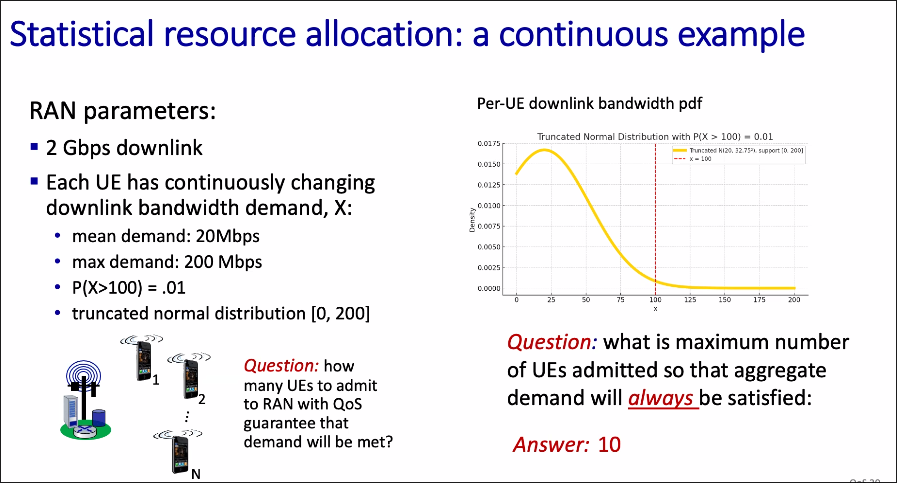
- ?????????????? why not concrete?
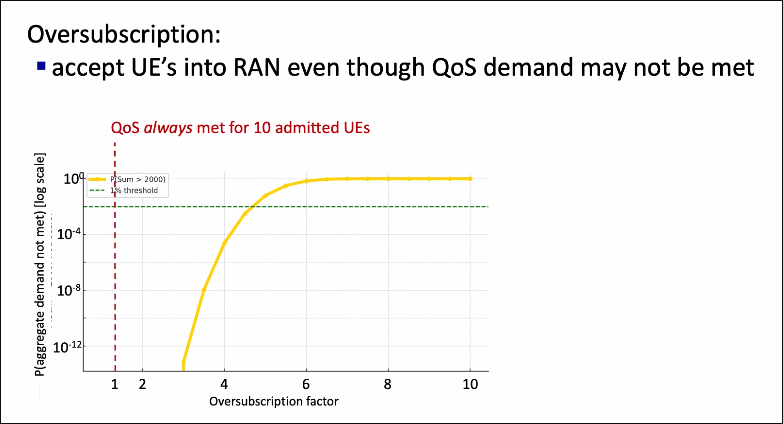
- oversubscription example